Sketchy times

Dear reader,
As you walk on the road, late morning, mid-summer, you see someone standing to the side. Just as your feet stomp the tar road’s seasonal glower with a chapelled move, you turn to glance at them. In that one step-see, you snapshot what they are wearing, how they slouch, and how they clutch on to a bag with both arms around it, as if it is a pet that could pounce on the road and run. In that singular glance, you know that though you do not know them, it is just as if you do. They are familiar.
You see them, and though you may not know them as this this person who lives across that that street, who likes eating mangoes with the skin unpeeled, who mumbles when they calculate how much change they have to give, you still recognise them. The familiarity is familial; you know many who resemble them, not in shape but in sensibility. You are sure that if you knew them and had stopped to have a conversation with them, they would say something that would make you stomp on the tar road harder as you walked away. You are sure that that would not be the last conversation you would have with them. You are sure that the next time, you will continue to stop and chat, for these are the people that make this place, your home. And a place becomes home when you know where the sharp objects are.
That is what I thought as I saw artist Latheesh Lakshman’s drawings at the Kochi biennale. They were sketches of people, a line here, a curve there, just enough detail for the knowing to bloom and wither as the recognition sets in. That’s home too, the place where there is no comfort in knowing.'
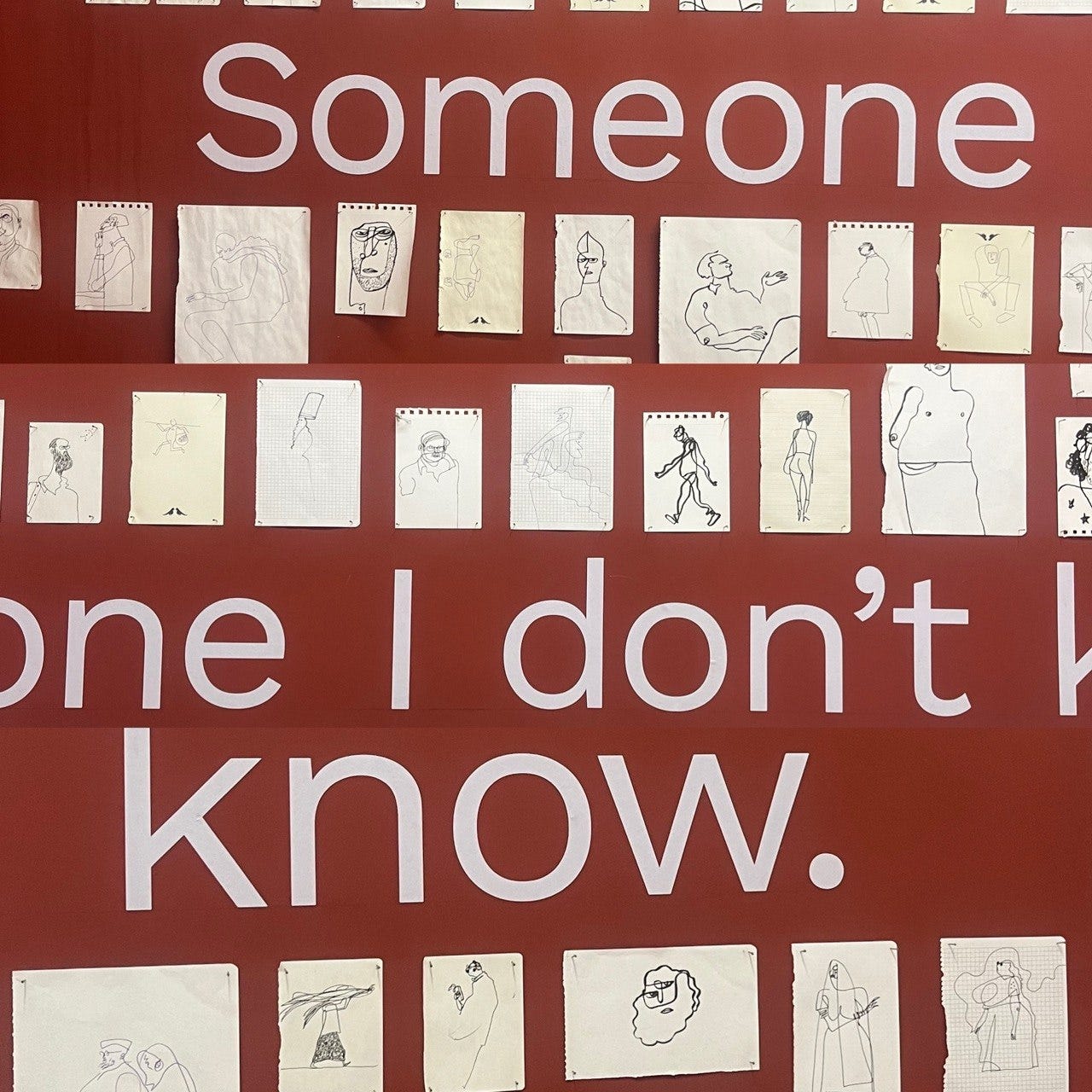
A composite of the photos I took at Kochi
Since seeing these images, the lines seem written all around, with just enough detail.
As I walked to the polling booth, I saw them. He stood there in a maroon t-shirt and a chequered lungi, with his arm first loosely around her waist, slowly tightening around her waist, as she fiddled with the phone to take their selfie with their inked fingers linked.
The line was short when I entered the matriculation school, and the women’s queue was shorter. Just as I joined it, she stepped onto the stairs, behind me, as if she had been waiting for someone else to go before her. She was in a brown top cutting an oval arc across her chest with a tattoo peeking out, some letters. I tried to make out what it was, but could not stare long enough to make out what it was. As I looked up, she smiled at me, and then turned away, now distracted by her phone.
Men and women alternated, a binary that existed nowhere else but in these queues. The two women ahead of me walked in together, and the men’s queue murmured, the volume just enough for me to hear and not reach the two inside now talking to the booth officers. The person who was to manage the queue was trying to pour the tea out from a plastic bag into a paper cup, and in that liquid minute, no one spoke. We were all trained to wait in different queues.
When the two women were almost done at the polling officer’s table, I nodded to the older man, signalling him to enter. “What is the hurry,” he chewed the words out rather than biting them. There had to be order. We follow rules. We are civilised. I did not say anything. The two women walked to the next table to get their fingers inked. He waited for that extra moment when the line in front of the polling officer dissolved into the room, which he sauntered into.
As I came out, I saw a young girl in a salwar kameez with her dupatta pinned on both sides help a grandmother walk across the road to the booth. They were both careful.